
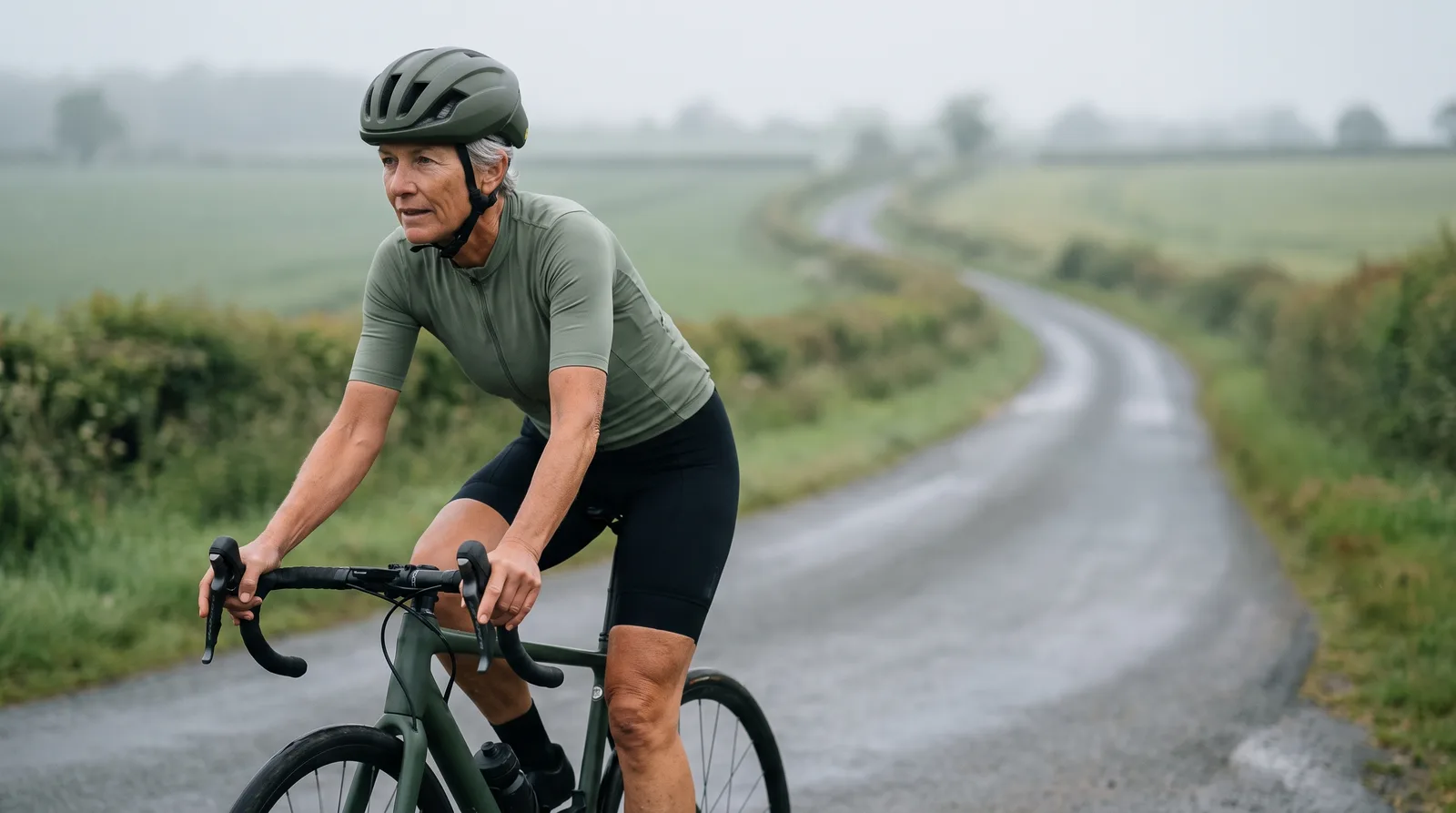
Age lowers the ceiling; it does not change the method. In master athletes who stay healthy and injury-free, performance declines in an attenuated, roughly linear way rather than falling off a cliff, and the rate of that decline is modifiable by training. Across five years in adults aged 70 to 77, those who trained at high intensity lost markedly less peak oxygen uptake than those who trained at moderate intensity, while weekly training duration showed weaker and less consistent associations. If something has to give, it is more often the easy volume than the hard session.
What actually changes with age
Physical performance rises from childhood to a peak in early adulthood and then declines, alongside reductions in muscle mass and quality and in multisystem physiological function. That much is not in dispute.
What master athletes add is the shape of the curve. A 2026 review of the master-athlete literature concludes that, under ideal conditions of being disease-free and injury-free, performance loss in these athletes follows an attenuated, linear course from early adulthood into advanced age — and that while lifelong training cannot halt age-related physiological deterioration, it can attenuate the rate of functional decline in cardiovascular, neurocognitive and musculoskeletal function (Eur J Transl Myol, 2026).
The same review notes that the performance gap between men and women narrows with age, particularly in endurance disciplines.
The practical reading is narrow but useful: ageing-related decay follows predictable rules, and its rate remains highly modifiable through sustained training. This is a review of the field rather than new data — treat it as the map, not the measurement.
The intensity finding, and how far it actually reaches
The most directly relevant recent number comes from the Generation 100 study. In a post hoc observational analysis, 500 participants aged 70 to 77 who consistently reported either high-intensity or moderate-intensity training were followed for five years, with peak oxygen uptake measured at four timepoints (Med Sci Sports Exerc, 2026).
- Men: high intensity −3.1%, moderate intensity −7.7% over five years.
- Women: high intensity showed no change; moderate intensity −4.6%.
- At five years the difference favoured high intensity by 1.31 mL/kg/min (95% CI 0.17–2.45) in men and 1.33 mL/kg/min (95% CI 0.28–2.37) in women.
- In exploratory analysis, higher reported intensity was associated with a smaller decline, whereas weekly exercise duration showed weaker and inconsistent associations.
That last line is the one worth keeping. It is the closest thing here to evidence for the familiar masters advice to protect the quality of your hard days before defending your weekly hours.
🔴 Now the limits, because they are large. This was an observational post hoc analysis, not a randomised comparison: people were grouped by what they reported doing, not by what they were assigned to do. Training intensity was self-reported. And the participants were 70 to 77 years old — this is not a study of forty-year-olds. The direction is informative; the specific percentages do not transfer to a 45-year-old rider.
Does recovery really take longer? The masters cyclists say: not the way you think
The idea that recovery slows with age is repeated everywhere. The one study here that put masters and young cyclists through the same session found something more specific.
Ten masters cyclists (aged 56 ± 5) and eight young cyclists (aged 26 ± 3), all well trained, rode 60 minutes at 95% of their second ventilatory threshold, followed by 40 minutes of supine recovery, with beat-to-beat heart rate measured throughout. The masters showed lower parasympathetic activity at rest and during parts of recovery — but similar heart-rate-variability responses during exercise, including at the onset and offset of the effort. The authors conclude that cardiac autonomic regulation during, or immediately following, this kind of session may not be influenced by age, and that masters athletes may simply sit at a lower baseline (Eur J Appl Physiol, 2025).
The consequence is practical. If your baseline sits lower, then a morning HRV reading compared against a general population table will look worse than it is. The number that means something is the one compared against your own recent normal.
⚠️ Eighteen riders, one session, one laboratory. This is not a basis for planning your week, and it does not prove that recovery never slows with age. It is a reason to stop assuming the opposite by default.
Strength work: what it buys a cyclist, and what it does not
A 2026 systematic review with meta-analysis pooled 17 studies and 262 endurance cyclists (60 of them female, mean starting VO2max 61.25 mL/kg/min) to test heavy strength training — defined as at least 80% of one repetition maximum — against cycling-only training. Interventions ran 5 to 25 weeks, at 1 to 3 sessions per week (Eur J Appl Physiol, 2026).
Compared with controls, heavy strength training improved cycling efficiency (effect size 0.353), anaerobic power (0.560) and cycling performance measured as time to exhaustion and time trial (0.463). It produced no significant change in VO2max, in power at VO2max, in maximal metabolic steady state, or in anaerobic capacity.
In other words: it makes you faster without making your engine bigger. The gain arrives through how efficiently you turn the pedals and how much power you can put out briefly — not through your aerobic ceiling.
🔴 Two honest caveats. The authors rate the certainty of this evidence as low, and say so explicitly: it does not support firm recommendations about how best to implement heavy strength training. And these were endurance cyclists aged 18 and over, not specifically masters riders; the analysis found no moderating effect of participant characteristics. So this is evidence that heavy strength training helps cyclists. It is not evidence that it helps more after 40 — that claim is plausible from the muscle-mass literature, but it was not tested here.
What this adds up to for your week
None of the above prescribes a plan, and the studies behind it were not designed to. What they do is narrow the sensible options.
- Protect the hard days before the hours. Intensity is where the evidence keeps landing; weekly duration is where it keeps being weak and inconsistent. On a compressed week, cut easy volume first.
- Judge recovery against yourself. A lower baseline is not a worse baseline. Trends in your own readings beat comparison with a table or with a younger training partner.
- Keep some heavy strength work in the week. The trials that showed a benefit used one to three sessions a week over five to twenty-five weeks. Treat that as the range studied, not as a prescription.
- Expect a slope, not a cliff. The review describes an attenuated, linear decline in athletes who stay healthy — and a rate that stays modifiable.
The unglamorous part is that this is the same advice that serves a thirty-year-old. What changes after 40 is the cost of getting it wrong: the medium-intensity week that buys nothing is more expensive when the hours are fewer and the recovery budget is tighter.
Your numbers, explained the moment you ask.
Peakfy has no masters mode, and that is deliberate — nothing in the evidence above points to an age switch that should flip at 40.
What it does instead is the thing this evidence actually asks for. Readiness is computed against your own 60-day baseline of HRV, resting heart rate and sleep, rather than against a population table — which is precisely the distinction the masters-cyclist study points at. The morning check-in weighs how you feel alongside what the sensors measured. Weekly availability means the plan is built inside the hours each weekday genuinely allows, so a compressed week loses easy volume instead of quietly losing the session that was supposed to be hard. And when you want to know why today looks the way it does, you ask — and the answer arrives with the data it came from.
Questions riders ask
Keep reading
- Recovery and readiness in cycling: reading the morning signals
- Can you trust your readiness score? What the research says
- How to increase your FTP: what actually moves the number
- Cycling training zones explained: what each one is for