
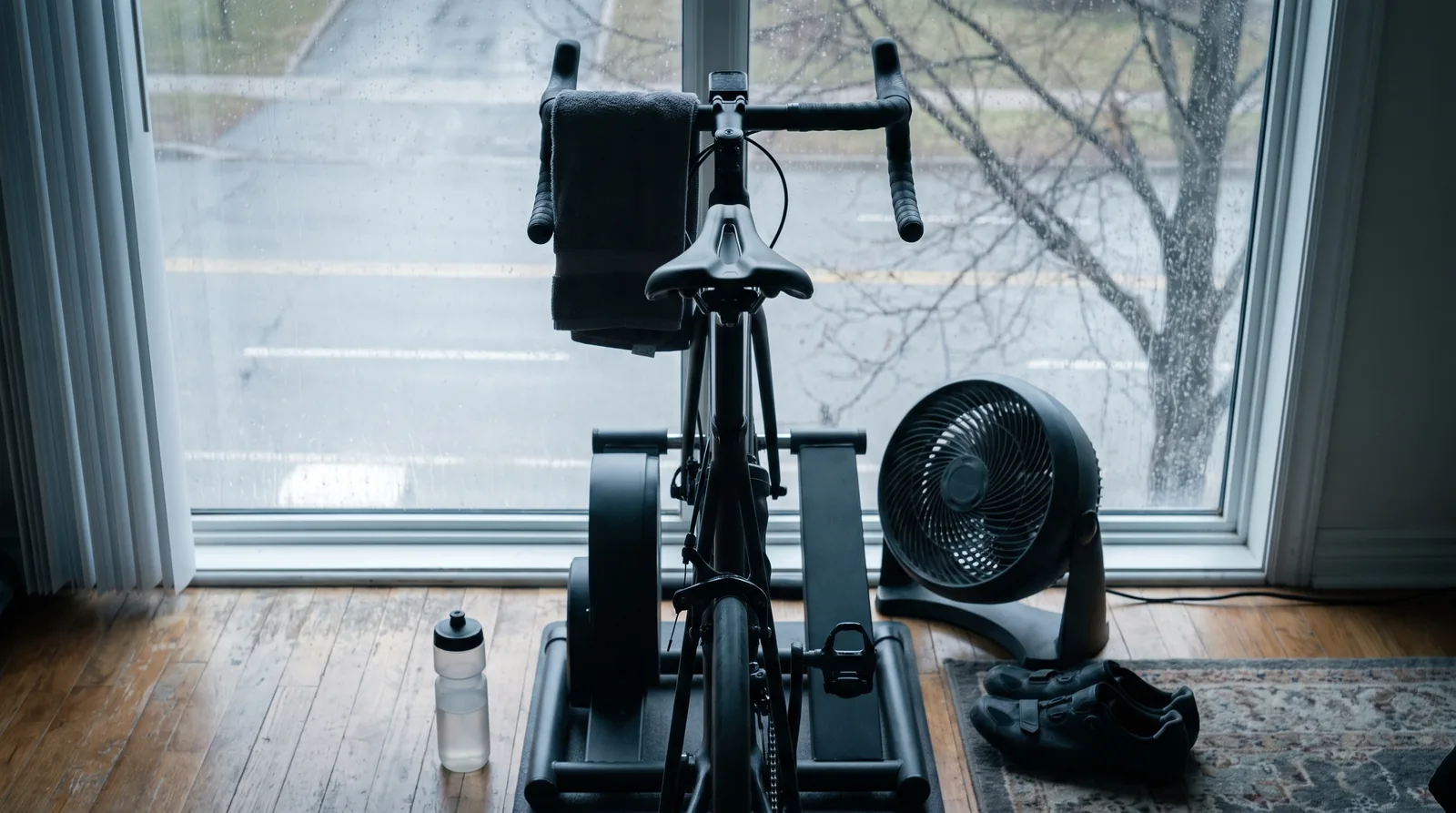
Neither. They are good at different jobs. Precision intervals belong indoors, where nothing interrupts them. Long endurance, descending, pacing and handling belong outdoors. The riders who improve fastest use whichever removes the excuse that week.
Why the same watts feel harder indoors
It is not your imagination. Without airflow you overheat faster, and heat raises heart rate at any given power. There is no freewheeling, no descents, no junctions — the pedalling is relentless in a way road riding almost never is. And the mental load of staring at a wall is real.
Practical consequences: use a proper fan, expect heart rate to sit higher for the same watts, and do not be alarmed if your indoor FTP tests a few percent below your outdoor one. Compare like with like and keep one environment for testing.
Which sessions belong where
Indoors wins for short, precise intervals where a red light ruins the effort; for consistency in bad weather or darkness; for time efficiency when an hour is genuinely an hour; and for anything requiring exact power control.
Outdoors wins for long endurance rides, because time passes differently and the aerobic work is the point; for learning to pace an effort that nobody is holding steady for you; for descending, cornering and riding in a group; and for the fact that it is why most people ride at all.
The indoor platforms are complements, not rivals
Worth saying plainly: the indoor world has largely standardised on consuming a plan made elsewhere. The major platforms are built to ingest structured workouts from other tools rather than to replace your coach.
That means the choice is not "training app or indoor platform". It is which tool decides what you ride, and which one you ride it in. Treating them as competitors is how riders end up following two plans that disagree.
Is the indoor mental load real? Partly — and the split is the interesting bit
Saying that indoor riding is mentally harder is easy. Someone measured it under conditions that make the comparison fair.
Ultra-distance cyclists completed a 5-hour continuous ride at 65% of FTP indoors and the same ride outdoors, in counterbalanced order. The two were genuinely matched: mean outdoor power 169.1 ± 40.3 W against mean indoor power 168.5 ± 40.7 W, with no significant difference. Before and after each ride the researchers recorded EEG, heart-rate variability, a psychomotor vigilance test and the NASA-TLX workload questionnaire (Sports, 2022).
What riders felt: the mental demand score was roughly twice as high indoors — 319.6 ± 125.6 against 164.6 ± 114.9 outdoors (p < 0.009).
🔴 What the instruments found: nothing to match it. There were no significant differences between the indoor and outdoor rides in EEG theta power, in the vigilance test, or in post-ride heart-rate variability. Both rides produced changes against their own baseline; neither environment produced more than the other.
So the honest version is narrower than the folklore. Riding indoors is experienced as markedly more demanding, and that experience is worth planning around, because it is what decides whether you finish the session. But at five hours and matched power, it did not show up in the objective markers of mental workload. The authors note this does not replicate findings from shorter, harder efforts such as 20 km time trials.
⚠️ Eleven riders, one protocol, one duration. A single well-designed study, not a settled question.
What outdoor riding is measurably better at
The other half of the comparison is not about physiology at all, and it is the half that decides how much you actually ride.
In a randomised crossover trial, 31 adults cycled outdoors and indoors, the indoor sessions supported by virtual and enhanced reality. Outdoor cycling produced significantly higher enjoyment, higher intrinsic motivation and stronger intention to exercise outdoors again — all at p < 0.001 — while the two indoor technologies did not differ from each other (J Funct Morphol Kinesiol, 2024).
That is a result about adherence dressed as a result about enjoyment. The best session is still the one you do, and a plan that quietly relies on you enjoying every hour indoors is a plan with a leak in it.
⚠️ Thirty-one young adults and short sessions, and the rides were not matched for power — so read this as evidence about motivation, not about physiological cost.
Your numbers, explained the moment you ask.
The thing that actually decides whether a week works is not the venue. It is whether the session in front of you fits the shape of your day and the state you are in — and whether you get a straight answer when the plan says threshold and the weather says otherwise.
Peakfy writes each session with the interval profile, exact power and heart-rate targets and fuelling per hour, so it reads the same whether you ride it on the road or on a trainer. When you swap a session, you can ask what that costs — the conversation has no counter and nothing to top up.
Questions riders ask
Keep reading
- Cycling training zones explained: what each one is for
- How to increase your FTP: what actually moves the number