
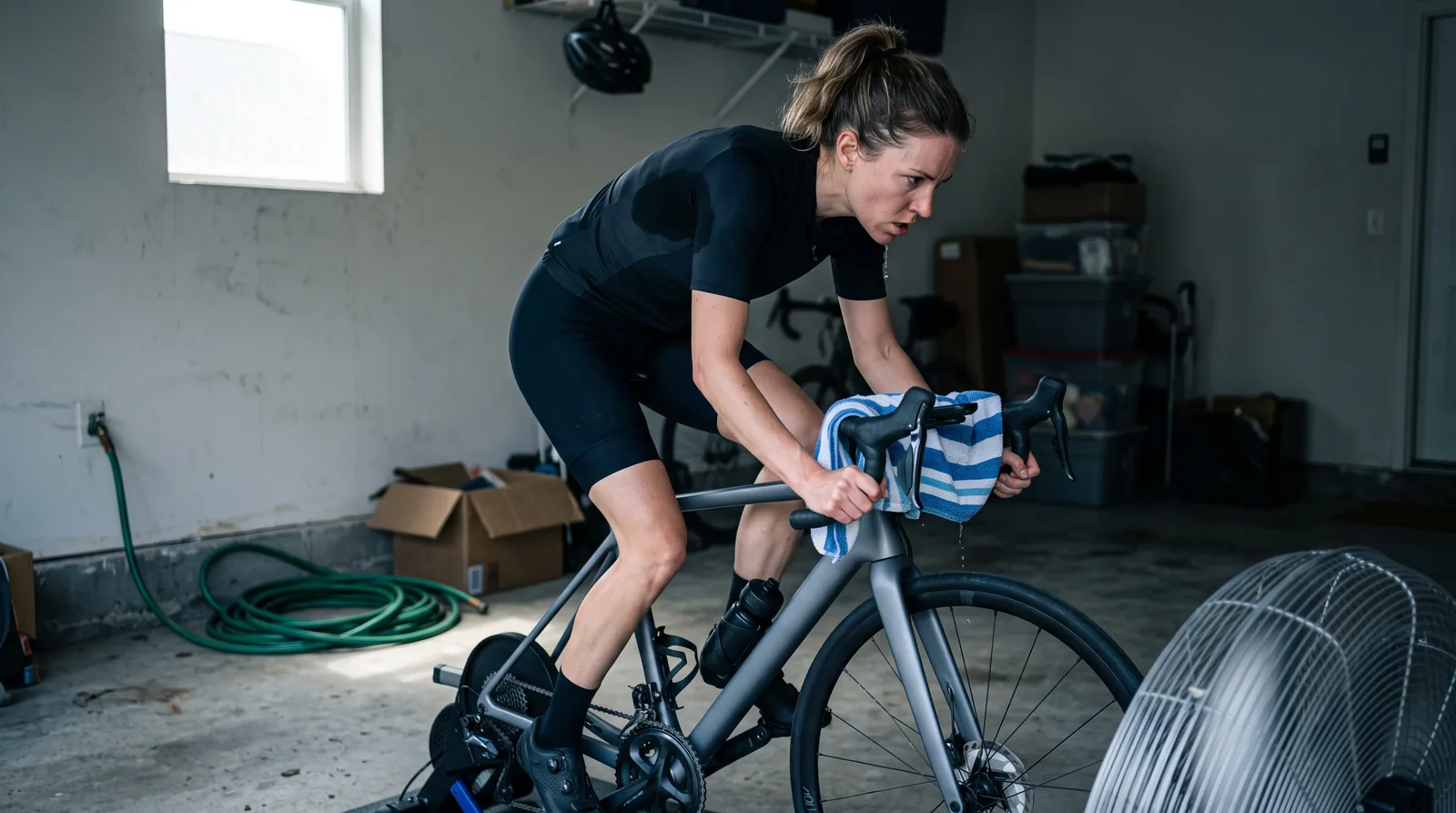
FTP — functional threshold power — is the highest power in watts you could hold for roughly an hour. It is not a fitness score. It is the anchor every training zone is calculated from, which is why a wrong FTP quietly makes every session the wrong intensity.
What the number actually means
Think of FTP as the line between two states. Below it, your body can clear the by-products of hard riding roughly as fast as it makes them, so you can keep going. Above it, the balance tips, fatigue accumulates, and a clock starts running on how long you last.
That is why FTP matters more than any single power number: it is the intensity where the physiology changes. Every zone above it and below it is defined in relation to that line.
The two tests almost everyone uses
The 20-minute test. Warm up properly, then ride 20 minutes as hard as you can hold evenly. Take about 95% of your average power. The 5% haircut exists because 20 minutes flatters you — most riders can hold more for 20 minutes than they could for an hour.
The ramp test. Power steps up every minute until you cannot continue. Your FTP is estimated from your best final minute. It is shorter, easier to face, and easier to repeat consistently — but it rewards riders with a strong anaerobic kick, which can hand you an FTP you cannot actually sustain.
Neither test is more "correct". What matters is picking one and repeating it the same way, on the same equipment, in the same conditions. A trend measured badly but consistently is more useful than two accurate numbers you cannot compare.
How well does the number hold up?
FTP is usually described as an hour of power, and that description is doing more work than the evidence supports. It is worth knowing how the number behaves when someone checks it properly.
One laboratory study compared FTP — taken as 95% of a 20-minute time trial — against critical power in 17 moderately trained cyclists and triathletes. The two agreed closely on average: a mean difference of 7 ± 13 W and a very strong correlation (r = 0.969). But the limits of agreement ran from −19 to +33 W, and the typical error was 13 W, or 5.6% — which the authors point out sits above the 5% usually accepted in sport science. Their own wording is careful but pointed — arguably, they write, these findings question the underlying physiology of the FTP concept (Front Physiol, 2020).
Read that carefully, because it cuts both ways. For a group, FTP lands in about the right place. For you, on a given day, it can sit thirty watts away from the physiological line it claims to mark.
🔴 The limits: 17 riders, one laboratory, moderately trained, a single study. It does not mean FTP is useless — the whole point of an anchor is that it is stable enough to train from. It means you should treat the number as a working reference you adjust by feel and results, not as something measured.
Where you test changes the number
Riders often notice their outdoor numbers beat their indoor ones and assume the trainer is reading low. There is measured evidence that the environment itself moves the result.
Nine junior road cyclists performed a full set of laboratory tests and then a 20-minute time trial on an uphill road. Outdoor FTP came out at 269 ± 34 W, against a laboratory critical power of 236 ± 24 W and a 4-mmol lactate power of 233 ± 23 W. The outdoor 20-minute power was 12% higher than the indoor power–duration relationship predicted, and the resulting FTP sat 14–15% above both laboratory thresholds (J Strength Cond Res, 2023).
That is a large gap, and it is not a calibration error. Cooling, position, the steady resistance of a climb and the simple fact that you cannot freewheel all push outdoor numbers up.
🔴 The limits: nine male juniors, one uphill course. The direction is worth carrying; the exact percentage is not. The practical rule stands either way — test in one environment and compare like with like, and if you set zones from an outdoor test, expect indoor sessions at those targets to feel harder than they should.
Why your FTP drifts even when you feel the same
Heat, altitude, sleep, how recently you ate, and where you are in a training block all move the number. So does your trainer's calibration and even the tyre pressure on a wheel-on unit. A 3–5% swing between two honest tests is normal and does not mean the training failed.
The practical rule: react to a trend across several weeks, never to a single test. One bad number on a hot Tuesday is not a signal.
How often to retest
Every six to eight weeks is plenty for most riders, or after a block that clearly changed something. Testing more often costs you a hard session each time and gives you noise rather than information.
There is a shortcut worth knowing: if your best 20-minute power in normal training keeps beating your last test, your FTP has already moved. You do not always need a formal test to know that.
Your numbers, explained the moment you ask.
The awkward truth about FTP is that the test is the easy part. The hard part is noticing, six weeks later, that your zones no longer match the rider you have become — and that every session since has been slightly too easy.
Peakfy estimates your FTP from the riding you already do and keeps the zones moving with it, so the targets on tomorrow's session reflect this week rather than the last time you suffered for 20 minutes. And when the number changes, you can ask why and get a straight answer instead of a new figure appearing without explanation.
Questions riders ask
Keep reading
- How to increase your FTP: what actually moves the number
- Recovery and readiness in cycling: reading the morning signals
- Critical power vs FTP: which number should guide your training?