
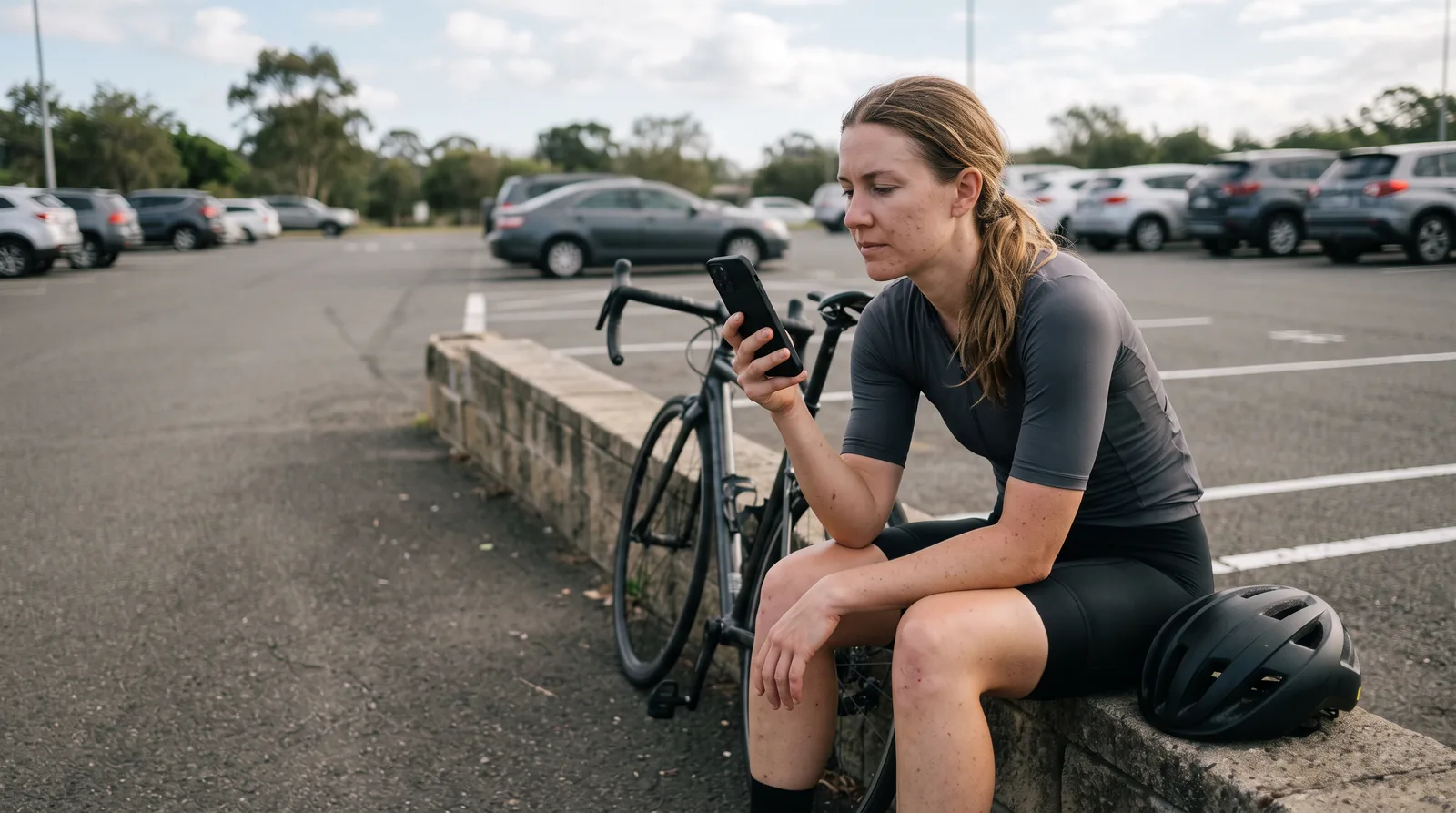
A human coach gives you accountability, judgement about your life, and someone who is responsible for you. Software gives you availability, consistency and a plan that reacts to today's data at 6 a.m. on a Sunday. They are good at different things, and the honest answer for many riders is that the limiting factor is not the plan.
What a human coach does that software does not
They know things you did not tell them. That your job gets brutal every quarter-end. That you always overreach in March. That when you say you feel fine, you are being polite.
They create accountability. This is the part riders underrate and then discover. A person who will notice you skipped Thursday changes behaviour in a way no notification does. On cycling forums it is a recurring theme that people paying for coaching say they are paying for exactly this, not for the workouts.
They take responsibility. A good coach carries some of the decision, and the reassurance of that is real.
None of that is replaceable by software, and anyone telling you otherwise is selling something.
What software does better
It is there at the moment you need it. Most coaching questions arrive at inconvenient hours: standing in the kitchen at six on a Sunday morning, deciding whether today's session survives contact with how you feel.
It is arithmetically consistent. Training load, readiness, zones and an FTP estimate get computed the same way every time, from every ride, without anyone running out of hours.
It never gets tired of your questions. There is a real cost to feeling like you are bothering someone. Riders self-censor with human coaches and then act on a guess.
It costs a fraction. Coaching in Europe commonly runs from tens to well over a hundred euros a month. That gap is why the comparison exists at all.
A plan is not the training
Before choosing between a coach and software, it is worth knowing how well either one survives contact with a real week. There is a measurement of exactly that.
Researchers followed two coaches and their junior speed skaters through a four-week preparatory block, recording what the coaches intended session by session and what the athletes actually did: 438 intended sessions against 378 executed ones. Intended training time was 52 hours 37 minutes; what got done was 45 hours 16 minutes — roughly four sessions fewer. The shortfall was not evenly spread: strength sessions slipped most, while skating sessions were done at an RPE about 0.6 lower than intended. Individual variation was large, with some athletes exceeding the plan and others well under it (Int J Environ Res Public Health, 2022).
There was a coach standing right there. The gap opened anyway, and it opened differently for each athlete. Whichever way you go, the useful question is not who writes the plan — it is who notices, quickly, when the plan and your week stop matching.
🔴 The limits: 14 junior speed skaters, one four-week block, training logs filled in by the athletes themselves, observational. The study also found that athletes who came closer to the coach's intentions reported a better sense of success and recovery — a correlation, not proof that pushing harder causes either.
Where adjusting measurably helped — and what it does not prove
The other half of the question has been tested too. Thirty recreational runners were split between a fixed plan and one where the load was raised, held or lowered twice a week based on nocturnal heart-rate variability, perceived recovery and a heart-rate-to-speed index. Over fifteen weeks, 10-kilometre time improved by 6.2% in the adjusted group against 2.9% in the fixed group (p = 0.002). In that 10-kilometre test, 81% of the adjusted group were high responders against 23% of the fixed group, and while 8% of the fixed group finished moderately worse than they started, none of the adjusted group did (Med Sci Sports Exerc, 2022).
🔴 Now the part that matters for this article, and it cuts against the easy conclusion: that study did not test AI. It tested whether adjusting the load to the athlete beats leaving the plan alone. A human coach does exactly that, and often better, because they can weigh things no sensor records.
So the honest version of the comparison is not machine against person. It is: adjustment beats no adjustment, and what actually differs between a coach and software is how often the adjustment can happen, what it costs, and what each one can see. A coach sees your life. Software sees every ride, every morning, for the price of a monthly subscription. Neither of those is a small advantage, and neither replaces the other.
🔴 The limits again: thirty runners, recreational, one study. Enough to take the principle seriously; not enough to promise anyone a number.
The honest limits of the AI label
It is worth being blunt about a word that is doing a lot of work in this category. "AI" is not a feature. Plenty of riders have had bad experiences with AI-branded training tools, and a fair amount of scepticism in cycling communities is well earned.
The questions that actually separate tools are duller and better: Are the numbers computed, or generated? Does the plan change when your data changes, or only when you edit it? Can it explain a decision in terms you can check against your own ride file? Judge on those, not on the label.
How to choose — and why “both” is common
A human coach makes most sense if you need accountability more than information, if you have a specific goal with a fixed date and real consequences, or if you have a complex history that needs someone to hold context you cannot write down.
Software makes most sense if you are self-directed but want the numbers to be right, if your week changes constantly, or if the cost of a human coach is the thing keeping you from any structure at all.
Plenty of riders run both: the coach sets the direction across the season, the app handles what today looks like. There is also a case that gets forgotten — one rider on a forum described paying a former WorldTour coach several hundred a month, moving to an app, and seeing FTP rise, because the app adapted better around missed sessions. That is a quality argument, not a price one, and it does not generalise to everyone.
Your numbers, explained the moment you ask.
Peakfy is built for the second case, and it does not pretend to be the first. It computes your training load, readiness, zones and FTP estimate from your real rides with deterministic maths, then explains what each number means and rebuilds today's session around how you actually are. You can push back, ask why, and disagree — with no counters and no credits to top up, so the conversation never has a meter running.
What it will not do is care whether you showed up. If accountability is your limiting factor, be honest with yourself about that first — a coach who texts you on Thursday may be worth more than any software, including this one.
Questions riders ask
Keep reading
- Can you trust your AI cycling coach? What the evidence shows
- Recovery and readiness in cycling: reading the morning signals
- A beginner cycling training plan that you will actually keep