
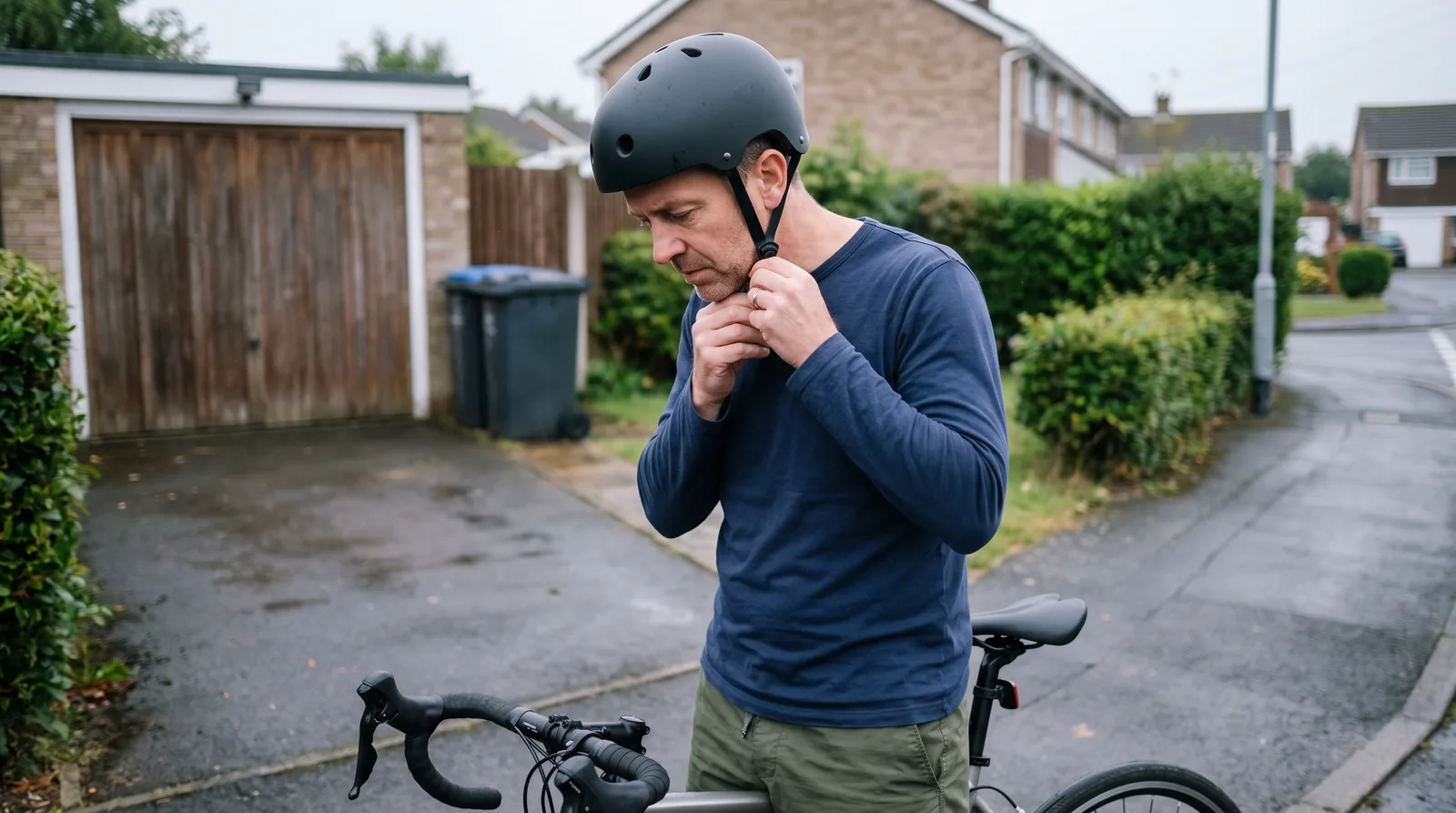
Three to four rides a week, most of them easy enough to hold a conversation, one slightly harder, and a rest day you actually take. Consistency over eight weeks beats intensity in any single one of them. The plan that survives contact with your life is the plan that works.
The shape of a first eight weeks
Three rides a week is the minimum that produces real change; four is comfortable for most people who have the time. Keep two or three of them genuinely easy — you should be able to speak in full sentences throughout. Make one slightly harder: a few longer efforts on a gentle climb, or ten minutes at a pace you could hold for maybe half an hour.
Grow the longest ride by roughly ten percent a week, and take every fourth week easier. That fourth week feels like cheating and is where the adaptation actually lands.
The two mistakes that end most beginner plans
Starting at the volume you wish you were doing. Enthusiasm writes a five-day plan; week three cancels it. Start below what feels possible. You can always add.
Riding every ride at the same medium-hard pace. It feels productive and it is the fastest route to being permanently a bit tired and never actually fresh. Easy days have to be easy for the harder day to be worth doing.
What to measure, and what to ignore for now
For the first couple of months, the useful measures are how often you rode and how you felt. Not average speed, which is mostly wind and terrain. Not comparison with anyone else.
If you have a power meter, an FTP estimate becomes useful once you have a few weeks of riding behind you. Before then it mostly measures how used to suffering you are, which changes faster than your fitness does.
When people actually quit, and what they say the reason was
Most advice about sticking to a plan is guesswork. The STRRIDE trials make it unusually concrete, because they recorded who stopped, when, and why.
Across three randomised trials, 947 adults were assigned to a control group or to one of ten supervised exercise programmes lasting six to eight months. Of those, 652 completed and 295 dropped out (Transl J Am Coll Sports Med, 2022).
- 🔴 67% of the people who dropped out did so before the programme had even reached its prescribed volume and intensity — during the ramp-up, or before starting it.
- The most commonly reported reason was lack of time (40%).
- ✅ Among those who got through the ramp-up, adherence did not waver over the remaining six to eight months.
That last point is the encouraging one, and it is not what most people expect. The risk is not that you will get bored in month four. The risk is concentrated in the first few weeks, before the plan has become the thing you simply do.
⚠️ These were sedentary adults with overweight or obesity and raised cardiometabolic risk, in supervised research programmes — not cyclists starting a hobby. What transfers is the behavioural shape of the problem: when people stop, and what they blame. Not the specific percentages.
What that means for your first eight weeks
If two thirds of the losses happen before the plan reaches full size, then the ramp is not the boring part before the training. The ramp is the training, and it should be designed to be survived rather than to be impressive.
- Make week one embarrassingly easy. Not the week you could do — the week you could not fail to do, even if something goes wrong on Wednesday.
- Design against the time problem, because it is the one people actually report. A 40-minute ride that fits is worth more than a 90-minute ride that gets cancelled. Two short rides and one longer one is a more robust week than three long ones.
- Let the ramp be slower than your enthusiasm. Roughly ten percent a week on the longest ride is not timidity; it is the rate at which the plan stays intact.
- Judge the first eight weeks on rides completed, not on watts. The number that predicts your next year is how many times you got out of the door.
None of this is exciting, which is rather the point. The plan you keep is not usually the best plan on paper — it is the one built with the assumption that your week will go wrong occasionally.
Your numbers, explained the moment you ask.
The hardest part of a beginner plan is not writing it. It is what happens the first week life gets in the way — a missed Tuesday, a bad night's sleep, a work trip. A fixed plan just carries on as though none of that happened, and the gap between the plan and your week widens until you quietly stop opening it.
Peakfy rebuilds the week around what actually happened, keeps the easy days honestly easy, and explains each session in plain language rather than assuming you already speak the vocabulary. You can ask why today looks the way it does, as often as you like — there is no counter and nothing to top up.
Questions riders ask
Keep reading
- Cycling training zones explained: what each one is for
- Zone 2 heart rate cycling: how to ride easy without a power meter
- What is FTP in cycling, and how do you test it?
- What to do with your training plan when life gets in the way
- AI cycling coach vs human coach: an honest comparison