
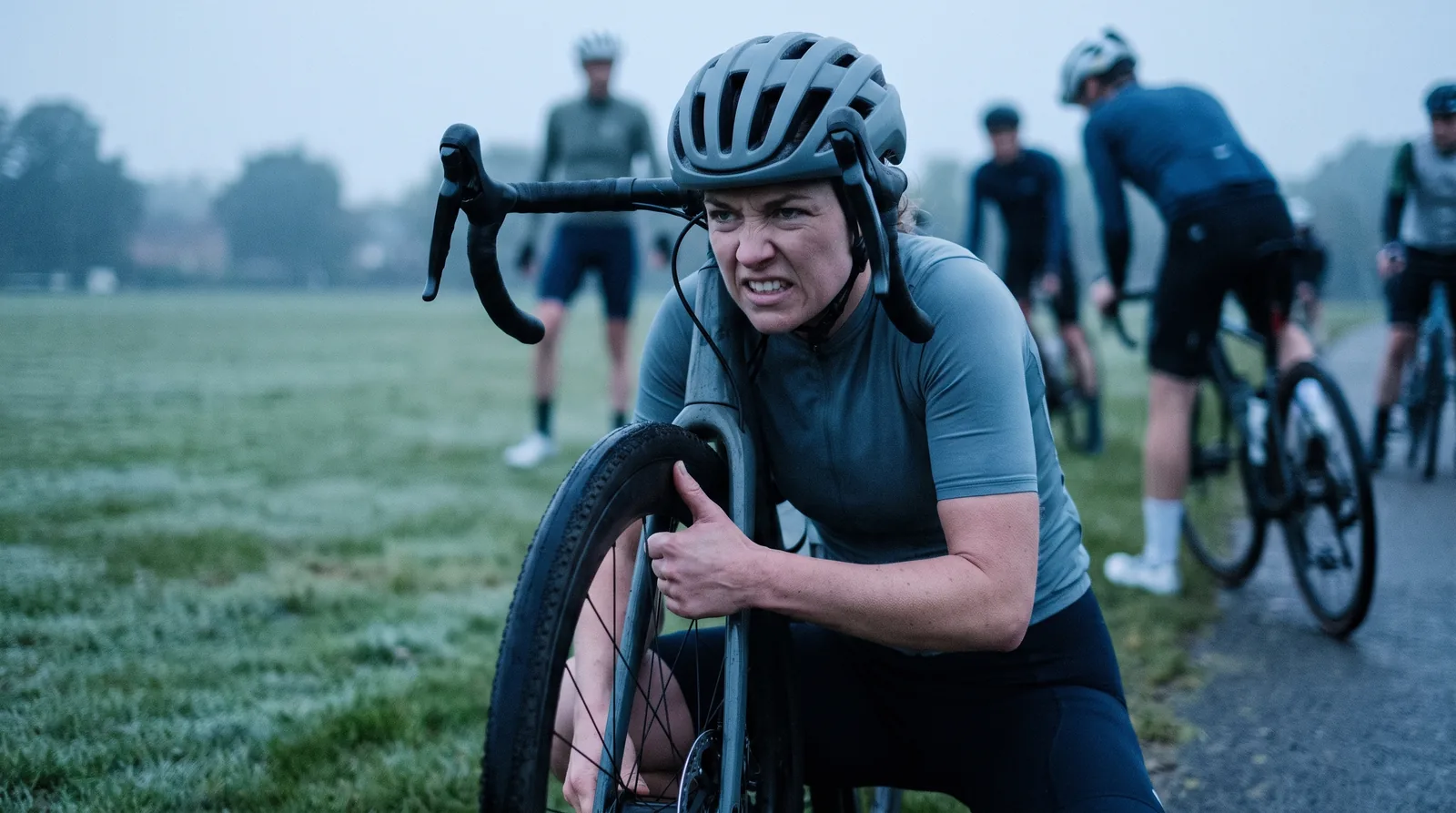
A road race is not a steady effort. It is repeated hard surges with recovery in between, decided by positioning as much as by fitness. Train short, sharp repeats, practise riding close to other people, and accept that your first race is for learning, not for results.
What a race actually asks of you
Most people train steady and then discover that racing is nothing like that. The power file of a road race is spiky: a hard surge out of every corner, a scramble to close a gap, a climb ridden far above threshold, and then recovery in the bunch.
So train the shape of it. Add short, repeated efforts of 30 seconds to 3 minutes with incomplete recovery — the ability to go hard again while still breathing from the last one is the specific quality a race demands, and it is not the same thing as a high FTP.
The skills that matter more than fitness
In a first race, bike handling and positioning decide more than watts. Practise riding shoulder to shoulder with people you trust. Learn to hold a wheel, to corner without braking in the middle, and to move up the outside without panicking.
Sitting in the wheels genuinely costs far less than riding in the wind. A rider who stays out of the wind for an hour has spent much less than one who drifts to the front repeatedly, regardless of who has the higher FTP.
The last week, and the start line
Cut the volume, keep a couple of short sharp efforts, sleep. Nothing you do in the last week makes you fitter. Check your bike days before, not the night before, so a mechanical problem is an inconvenience rather than a crisis.
Eat properly beforehand and take something to eat with you even for a short race. And set the goal correctly: finish in the bunch, do not get dropped on the first climb, learn where you lost position. That is a successful first race. Results are for the second one.
Why the surges cost more than the average suggests
Everyone knows a race is spiky. What is less obvious is that the spikiness has a price of its own, separate from how hard you rode on average.
Nine well-trained cyclists and triathletes completed two one-hour rides in randomised order: one at constant power, one at variable power made of intervals between 40% and 135% of maximal aerobic power lasting 10 to 90 seconds. The two rides were matched for mean power output. Before and immediately after each, they did a maximal 30-second sprint (Front Physiol, 2019).
🔴 After the variable hour, the sprint was worse: peak power down 5.1 ± 6.1% and mean power down 5.9 ± 5.2% compared with the constant hour. Same average watts, measurably less left at the end.
This is the number behind the old advice to stay out of the wind. Sitting in is not only about the energy you save — it is about not spending it in bursts. Every gap you close, every corner you brake into and then jump out of, is a small withdrawal from the sprint you were hoping to have.
⚠️ Nine riders, in a laboratory, over one hour, in a criterium-style profile. Take the direction seriously and the exact percentages lightly.
What that changes about how you ride your first race
If variability itself is expensive, then most of the useful skills in a first race are the ones that smooth it out.
- Position before the corner, not after it. Arriving badly placed means braking and then sprinting back up to speed. Two or three of those per lap is a session's worth of intervals you did not plan.
- Close gaps early and gently. A gap of two metres costs almost nothing. The same gap at ten metres costs a hard effort, and you pay it while already tired.
- Move up steadily on the outside rather than in bursts. The steady version is slower and cheaper, and cheap is what you want with an hour still to go.
- Train the shape, not just the size. Repeated 30-second to 3-minute efforts with incomplete recovery rehearse exactly this — going hard again while still breathing from the last one.
None of this makes you fitter. All of it makes the fitness you have last until the part of the race that decides anything.
Your numbers, explained the moment you ask.
The gap between endurance training and race-specific training is where most first-timers get caught. The sessions that build a good FTP are not the sessions that teach your legs to recover from a surge and do it again ninety seconds later.
Peakfy writes each session with the interval profile and exact power and heart-rate targets, and adapts the week around the state you are actually in — so the sharp work lands on days you can execute it, not on days the calendar chose six weeks ago. And when you want to know why today changed, you ask, without a counter running.
Questions riders ask
Keep reading
- How to increase your FTP: what actually moves the number
- Cycling training zones explained: what each one is for
- How to train for a gran fondo without wrecking yourself