
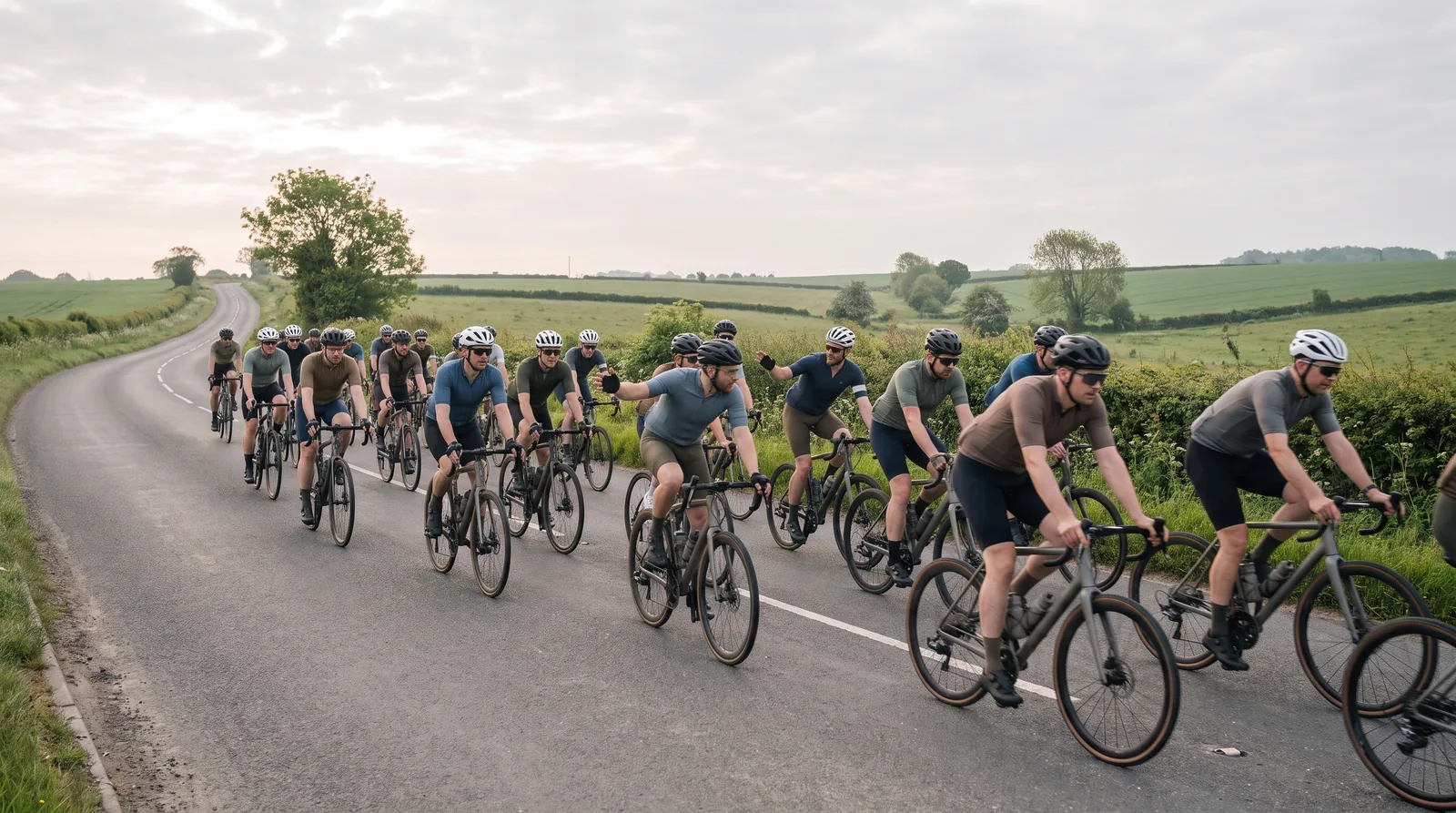
Build one long ride a week toward roughly 70–80% of the event distance, keep the rest of the week mostly easy with one quality session, and rehearse your fuelling on every long ride. Most people who struggle on the day were not underprepared in fitness. They were underprepared in pacing and eating.
How long the long ride really needs to be
You do not need to ride the full distance in training. Reaching roughly 70–80% of the event, once or twice, in the six weeks before, is enough for most riders — the extra comes from adrenaline, the group, and a taper you actually take.
Build that ride gradually: add around ten percent a week, and take a lighter week every fourth. Match the terrain if you can. A flat five-hour ride is poor preparation for five hours of climbing, even at the same duration.
The week around it
One long ride, one quality session, and the rest genuinely easy. That is the whole structure. The quality session is where sweet spot or threshold work lives; the easy rides are what let you arrive at both of those able to do them properly.
In the final two weeks, cut volume noticeably but keep some intensity — short, sharp efforts keep you feeling like a cyclist while the fatigue drains away. Resist the urge to cram. Nothing you do in the last ten days will make you fitter; plenty of it can make you tired.
Pacing and fuelling — where the day is actually decided
Pacing: the first climb will feel easy and that is the trap. Riding the first hour ten watts too hard is paid back with interest in the fourth. Have a ceiling you refuse to exceed early, especially in a group that is going faster than your plan.
Fuelling: aim for a consistent intake per hour from the start rather than eating once you feel empty — by then it is too late to catch up. Practise the exact products at the exact intensity on your long rides. A gut that has never seen 70 g of carbohydrate in an hour will not learn it on event day.
The three mistakes that end a first gran fondo
Ask riders what went wrong and the answers converge. Not one of them is a fitness problem.
- Starting too fast. The first hour feels free — fresh legs, a big group, adrenaline. It is not free. It is borrowed, and the interest is charged in the last two hours.
- Going too deep on the first big climb. A climb is where a group shatters, and holding the wheel of riders who are stronger than you costs far more than the minutes it saves. Ride your own gradient and let them go.
- Falling behind on food and never catching up. Carbohydrate is not a debt you can repay later. Once you are empty, the intake that would have kept you going is no longer enough to bring you back.
All three are decisions rather than capacities. That is the encouraging part — they are the cheapest things on this page to fix.
What riders actually eat, versus what they planned
A fuelling plan and fuelling behaviour are not the same thing, and the gap has now been measured rather than surveyed. Sixty trained non-elite endurance athletes — 22 of them cyclists — were followed through two official races. Intake was not self-reported: sports products were weighed before and after the race and combined with food diaries (Eur J Sport Sci, 2025).
- Across the whole group, actual intake was 31.7 g of carbohydrate per hour against a planned 38.0 g/h.
- The cyclists planned and achieved considerably more than the runners — 58.9 g/h planned, 49.1 g/h actually consumed — and still fell around 10 g/h short.
- Proportionally the shortfall was the same in both groups, roughly 16–17%.
- Athletes overestimated what they had taken in, and the overestimation was worst with gels, which had the highest leftover rate.
- Better sleep behaviour and lower pre-race anxiety predicted higher actual intake.
The practical reading is blunt. Plan a number you can miss by a sixth and still be fine, and check your pockets at the finish instead of trusting the feeling of having eaten. A wrapper you still have is a gel you did not take.
⚠️ Twenty-two cyclists across two races is a small sample, and these were trained athletes rather than first-timers. Take the direction from it, not the exact grams. How much to aim for in the first place is a separate question, covered in carbohydrates per hour.
Stomach trouble is probably not about what you ate
The standard explanation for a bad stomach on event day is the food. A study of a real mass-participation event suggests that is often the wrong suspect.
Riders at the 2023 Mallorca 312 were surveyed before the event (247 of them) and afterwards (138). Gastrointestinal complaints were reported by 38.4% during the race, against 22–26% in ordinary training and in previous events. On average the field met the recommendations, at 59.2 g of carbohydrate and about 500 ml of fluid per hour (Eur J Appl Physiol, 2025).
🔴 And no association was found between the symptoms and any nutritional measure or food intake. What the symptoms did track with was having gastrointestinal symptoms at rest in ordinary life, and with feeling more nervous immediately before the start — a feeling that was itself more common among riders with less experience of events like this.
Two consequences follow. If your gut is unhappy on normal days, that is your best predictor and it is worth addressing long before the event rather than on the morning. And if you are nervous on the start line, that is not a character flaw — it is a variable that shows up in the data, and it fades once you have done one.
⚠️ This is a questionnaire study of a single event with self-reported symptoms, so it shows association, not cause. It is a reason to stop automatically blaming the gels. It is not a reason to skip rehearsing your fuelling.
Your numbers, explained the moment you ask.
The two things that decide a gran fondo — pacing and fuelling — are also the two that are hardest to work out alone, because both change with the length and intensity of the specific ride in front of you.
Peakfy builds each session with the interval profile, exact power and heart-rate targets and carbohydrate and fluid per hour, computed from that ride's duration and intensity. So the long rides in your build are rehearsals of the day, not just distance. And when the plan needs to move because life moved, you can ask what that costs your event — as often as you like, with no counter running.
Questions riders ask
Keep reading
- How many carbs per hour cycling? A practical guide
- Durability in cycling: why your FTP does not predict hour five
- How to train for your first bike race
- Heat training for cyclists: what it does, and what it does not