
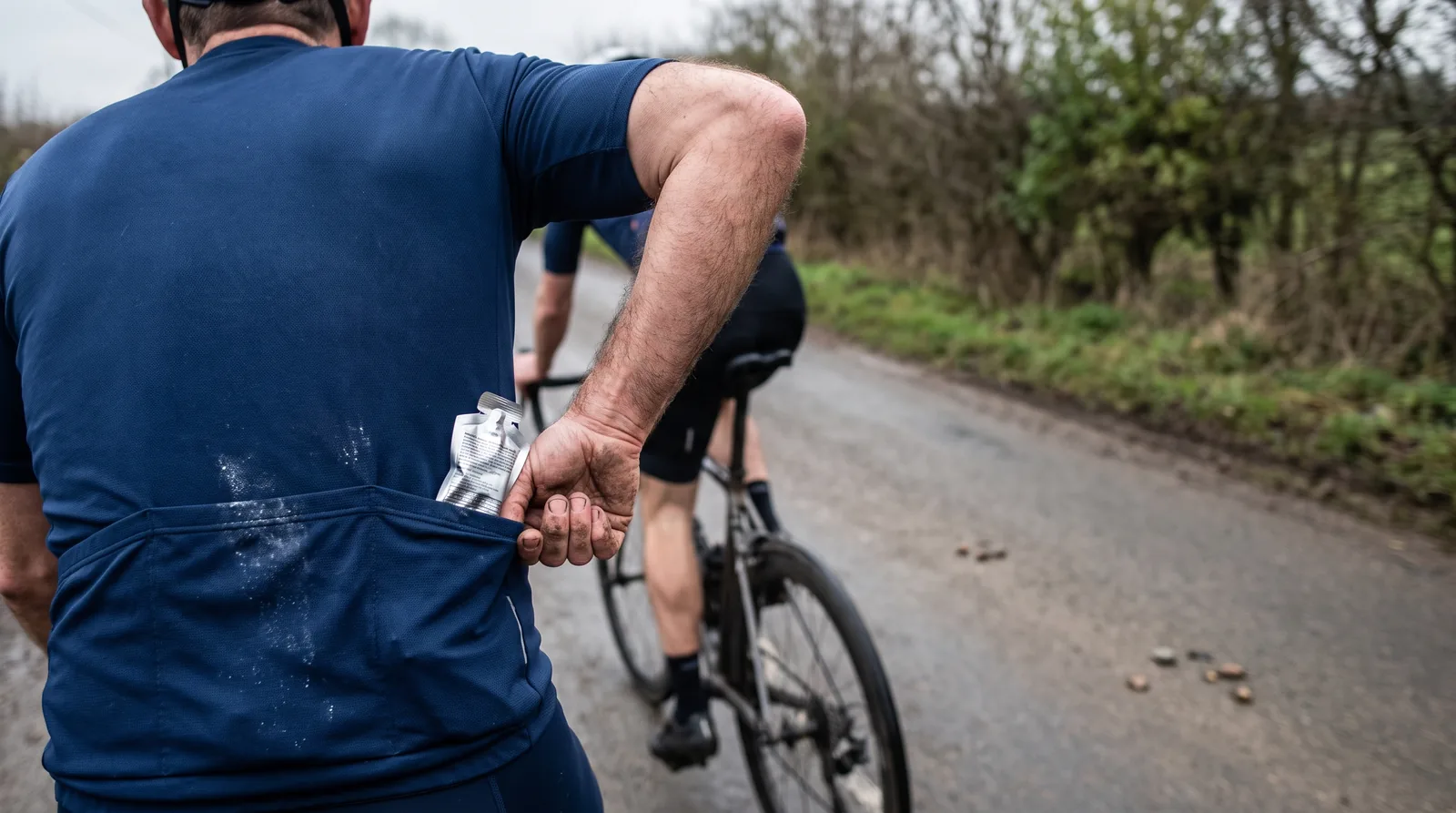
Most rides run well on roughly 30–60 g of carbohydrate per hour. On long or hard days, riders work toward 60–90 g/h — but only after training the gut to handle it. The professional peloton now fuels at 120 g/h and beyond, though research comparing those rates with 60–90 g/h has not shown a clear performance advantage. Under-fuelling is the quiet reason a good session falls apart in the last hour.
The dose, by how long and how hard you ride
- Under about 75 minutes, easy: water is usually enough. Your muscles already hold the fuel for this.
- One to two and a half hours, moderate: about 30–60 g of carbohydrate per hour.
- Long rides, or anything at race intensity: work toward 60–90 g/h.
Those bands are not a target to hit perfectly. They are a floor to stay above. Riders far more often eat too little than too much, and the cost shows up late — the last climb of a five-hour ride, not the first.
Why the top of the range needs two sugars
Your gut can only move so much glucose per hour, because it uses one transporter to do it. Fructose uses a different one. Combine them — roughly two parts glucose to one part fructose — and you can absorb meaningfully more per hour without the bloated, sloshing feeling that ends rides.
This is why almost every modern drink mix and gel lists both. It is also why plain table sugar works: it is already about half glucose and half fructose. Dates, bananas and rice cakes are not a compromise, they are food that happens to be correctly formulated.
What about 90–120 g/h, like the professionals?
The professional peloton has moved well past 90 g/h; riders now routinely describe 120 g/h and occasionally more. It is a real change in practice, and it is worth knowing precisely what the evidence behind it does and does not say.
What is established: at 120 g/h, using a maltodextrin-to-fructose ratio near 1:0.8 instead of the classic 2:1, trained cyclists oxidised roughly 17% more of the carbohydrate they swallowed than at 90 g/h. The ratio is the load-bearing detail — with a conventional 2:1 mix, feeding beyond about 110 g/h does not appear to raise oxidation any further.
What is not established is that it makes you faster. In that same experiment the extra intake spared no muscle or liver glycogen, and no performance test was run at all. A 2025 review of the practice in professional cycling states that available research does not directly support performance-enhancing effects of ingesting carbohydrate at 100 g/h or more relative to 60–90 g/h. And when elite trail runners raced on 120 versus 90 versus 60 g/h, the highest group finished with clearly lower muscle-damage markers and a lower internal load — but the race times were not significantly different.
Where it plausibly does matter is the case that review makes for stage racing: what you eat on the bike drives your total intake for the day. Across an event of eighty hours of racing, moving from roughly 70 to 110 g/h adds thousands of grams of carbohydrate over the whole race. That is an argument about being able to race again tomorrow, not about being stronger this afternoon.
So the practical reading, for anyone not riding a Grand Tour: 60–90 g/h that you actually manage beats 120 g/h in theory. One dose-response experiment that tested everything from 0 to 120 g/h put the estimated optimum at about 78 g/h. Go higher because your ride is genuinely long, your gut is prepared for it and your products are formulated for it — not because the number is fashionable.
The gut is trainable, and it is the part most riders skip
Tolerating 90 g/h is a skill, not a setting. Riders who jump straight there on race day get exactly the stomach they deserve. The fix is unglamorous: add 10 g per hour to your long ride, hold it for a week or two, then add another 10.
Practise with the exact products you will use on the day, at the exact intensity. A gel that sits fine in Zone 2 can behave completely differently at threshold, when blood is being pulled away from your digestive system toward your legs.
Fluid and heat change the drink, not the carbs
In normal conditions, drink to thirst. In heat, drink more and add electrolytes — but keep the carbohydrate target where it was. The two decisions are separate, and blurring them is how riders end up either dehydrated or over-concentrated and nauseous.
One practical rule: if the fuel is in your bottle, heat means diluting it and taking additional plain fluid, not diluting your fuelling plan.
What you eat after matters for tomorrow, not today
Refuelling is where the next session is won. Muscle glycogen resynthesis is slow, which is why riders in heavy training blocks often start each day with stores well below full — a pattern described in the sport-science literature on glycogen metabolism for coaches and athletes (Sports Health, 2018).
The practical consequence is undramatic: for recovery over a day or more, the total amount of carbohydrate you eat matters more than the timing or the type.
Your numbers, explained the moment you ask.
Here is the part that trips people up: the right number changes with every session. A 90-minute endurance ride and a three-hour day with threshold work are different fuelling problems, and working it out on the morning of the ride is how it gets skipped.
Peakfy puts the fuelling on the session itself — carbohydrate per hour and fluid per hour, sitting next to the interval profile and the power and heart-rate targets, worked out from that ride's duration and intensity. Not a food diary. A number on the plan you were going to follow anyway.
Questions riders ask
Keep reading
- Recovery and readiness in cycling: reading the morning signals
- Heat training for cyclists: what it does, and what it does not
- Indoor vs outdoor cycling training: which for which session