
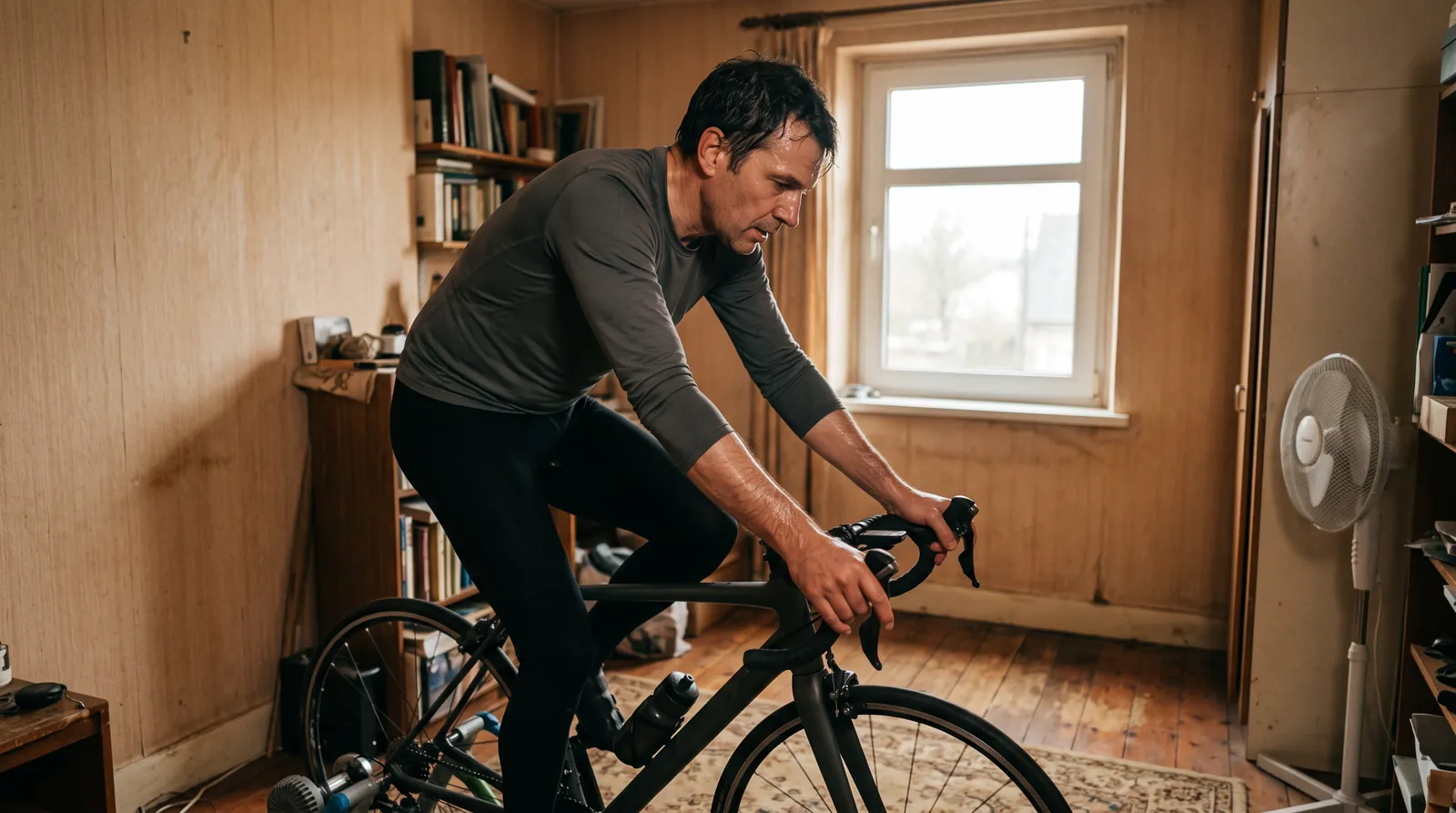
Heat training reliably improves performance in hot conditions. Across 211 studies and 2,587 participants, protocols averaging eight sessions of about 90 minutes expanded plasma volume by 5.6%, lowered end-of-exercise heart rate by 16.5 beats per minute and improved time-trial performance by 3.1%. The popular claim that it also makes you faster in cool weather rests on much weaker evidence — and the most convenient methods, a hot bath or sauna after training, are the ones with the least support behind them.
What heat training is actually doing to you
Ride hard in the heat and your body has two jobs competing for the same blood: feeding your legs and cooling your skin. Heat training works by making you better at the second job so the first one suffers less.
The main adaptation is that you carry more fluid in your bloodstream. Extra plasma means more blood to go around, so your heart moves the same oxygen at a lower heart rate. You also start sweating earlier and at a lower core temperature, which means you begin cooling before you are in trouble rather than after.
None of this is exotic. It is the same set of changes your body makes on its own during a hot fortnight in July — heat training just does it on purpose, and on a schedule you choose.
How big the effect is, from the largest analysis we have
In 2025 researchers pooled 211 studies covering 2,587 participants to model how heat adaptations develop. It is the best picture of this question that exists, and the typical protocol behind it was unglamorous: about eight exposures, roughly 90 minutes each, at around 39°C.
What that produced, on average:
Plasma volume rose 5.6% (3.8 to 7.0). Heart rate at the end of exercise fell by 16.5 beats per minute (18.7 to 14.0) — the single largest change in the dataset. Resting heart rate dropped 5.3 beats. Resting core temperature fell 0.19°C. Sweat rate rose by 163 millilitres per hour.
And for performance: time-trial results improved by 3.1% (1.8 to 4.5), while time to exhaustion rose by 49%. That last figure looks spectacular and is not the one to plan around — time-to-exhaustion tests are notoriously sensitive and inflate easily. The 3.1% on a time trial is the number that resembles a race.
One thing to hold on to before the next section: most of those performance gains were measured in the heat. That is what was tested, and that is what the number describes.
The cool-weather claim is the weak one
Somewhere in the last few years, heat training acquired a second reputation: not just preparation for a hot race, but a general fitness booster — the poor rider's altitude camp. This is where the evidence thins out badly, and it is worth being straight about it.
Take the rowing study that is often cited for this. Eleven national-level rowers, ten heat sessions, tested afterwards in a temperate 20°C laboratory. Plasma volume rose 19%, a big and clearly real physiological change. The four-minute time trial in cool conditions? A large effect on paper — but not statistically significant (p=0.13), from a heat group of five people. That is a promising signal, not a finding.
Then there is the meta-analysis of post-exercise passive heat — baths and saunas — which pooled the studies and found the effect on performance trivial in hot conditions (ratio of means 1.04, 95% confidence interval 0.94 to 1.15, p=0.46) and trivial again in thermoneutral conditions of 18 to 24°C. The reviewers graded certainty in every one of those estimates as low to very low, citing small samples, risk of bias and signs of publication bias.
The blood-building route does exist — pooled data show haemoglobin mass rising about 1.9 grams per additional day of exposure — but look at the dose. Those protocols averaged 12.5 days, and the elite cycling studies behind the headlines ran for five weeks using heat suits and environmental chambers. That is a training camp, not a fortnight on the turbo.
The honest summary: heat training is well supported for racing in the heat, and speculative as a way to get faster in November.
The at-home protocol that matches the strong evidence
Here is the part that surprises people: the method with the best evidence behind it is also the cheapest. It is riding indoors, deliberately hot.
Turn the fan off — or point it away. This is the single biggest lever, and it costs nothing. Add a layer, long sleeves and long bibs rather than a bin bag. Close the window.
Keep it easy. This is the part riders get wrong. The stimulus is the heat, not the watts. Ride at the effort you would use for a genuine recovery or endurance spin — the bottom of your training zones. Your heart rate will climb into territory that looks like a hard day anyway; that is the adaptation happening, not a reason to push.
Around 60 to 90 minutes, most days, for about two weeks. The pooled data suggest roughly eight exposures gets you most of what is available, and that longer sessions add a little more plasma volume than shorter ones.
Drink more than feels necessary, and have it within reach before you start. Sweat rate rises by the better part of a bottle over the course of the block, and that is the point of the exercise.
A word of ordinary caution, because this topic invites overdoing it: heat sessions feel harder than the power says, and stacking them next to hard training is how a good block turns into a bad month. If a session stops feeling like effort and starts feeling wrong, stop and cool down. And if you have any health condition at all, this is a conversation for your doctor, not for a training app.
Why the bath and the sauna are the convenient option, not the strong one
The best-known at-home shortcut is a hot bath straight after a normal ride, and it is genuinely appealing: no ruined training session, no suffering on the turbo, forty minutes with a book.
It does something. In a well-run study, thirteen active men ran for 40 minutes and then sat in a 40°C bath for up to 40 minutes, six days running. Two weeks later their resting core temperature was still 0.36°C lower, they began sweating 0.26°C earlier, their heart rate at the end of exercise was 14 beats lower and the same work simply felt cooler. Those adaptations were still there a fortnight after the last bath, which is longer than short heat blocks usually last.
But note what did not move: plasma volume rose 6% and that increase was not statistically significant. The headline adaptation was the one that failed to appear. And when the studies of passive post-exercise heat are pooled, the effect on actual performance comes out trivial, on low to very low certainty evidence.
So the bath is not nothing, and it is far easier to fit into a life with a job and a family. It is simply the option you should have the least confidence in — and it is worth knowing that before you build a race preparation on it.
Where it belongs in your week, and when to do it
Heat sessions are easy sessions that produce hard-looking data. That has two consequences worth planning around.
They still cost you something. Put them on days that were already easy, and keep them away from your quality work. A heat block layered on top of a hard training block is a good way to arrive at your event tired rather than adapted.
Your numbers will look wrong, and they are not. Expect heart rate 10 to 15 beats above normal at an ordinary endurance power, and expect your training load figures to read higher than the ride deserved. Nothing has gone backwards. You are seeing the cost of cooling, not a loss of fitness.
Timing matters because the adaptations fade. The retention data suggest a couple of weeks, so the sensible place for a heat block is the fortnight or so before a hot event — close enough to still be there on the day, far enough out that the fatigue has cleared. If your target is a hot summer gran fondo, that is the window.
And keep the rest of the plan intact. Heat changes how much you need to drink; it does not change how much you need to eat, which is covered properly in our guide to carbohydrate per hour.
Your numbers, explained the moment you ask.
The awkward part of a heat block is that your data stops making sense for a fortnight. Same power, heart rate 15 beats higher, training load reading like a race. This is exactly the situation where a number without an explanation does damage — you either panic about lost fitness or ignore the readings entirely, and neither is right.
You can ask the Peakfy coach why a ride came out that way and get an answer that names the reason rather than restating the number, along with what it means for tomorrow. It will also tell you when a value has not actually been computed instead of showing you a figure that looks plausible.
Questions riders ask
Keep reading
- How many carbs per hour cycling? A practical guide
- How to train for a gran fondo without wrecking yourself
- Cycling training zones explained: what each one is for