
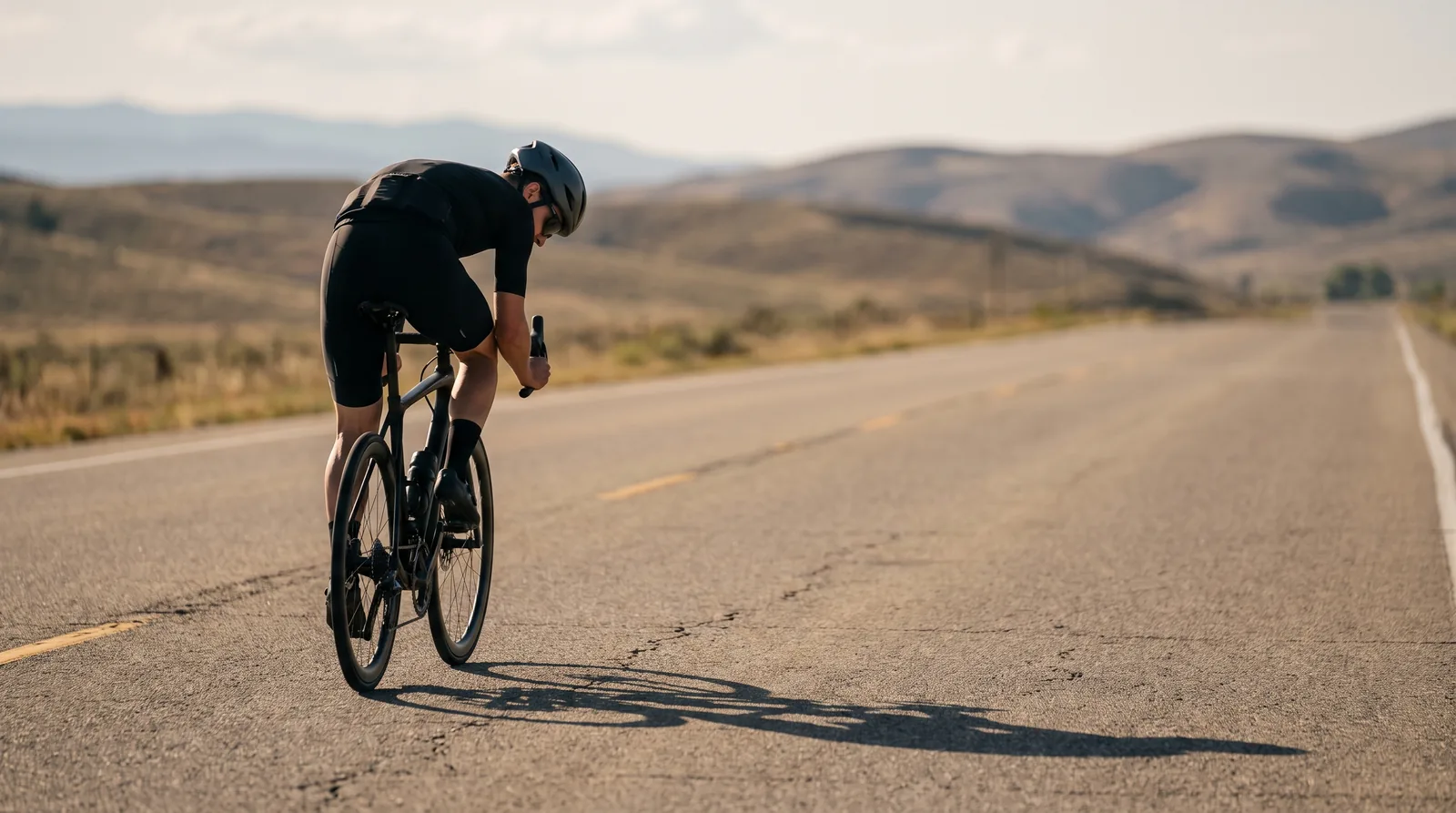
Durability is how much of your performance survives after several hours of riding. Two riders with an identical fresh FTP can be very different athletes at hour four — and almost every event that matters is decided there, not in the first hour.
Why fresh numbers mislead
An FTP test measures you rested. Almost nothing you care about happens rested. The climb that decides your gran fondo comes after three hours. The moment a group ride splits comes when everyone is already tired.
Durability is the missing dimension: how much of your threshold, your efficiency and your decision-making is still there after a large amount of accumulated work. Two riders with the same number on paper can finish an event twenty minutes apart because one of them still had their number at the end.
What actually builds it
Long rides, done regularly. There is no shortcut. Time on the bike, mostly easy, is what teaches your body to keep going efficiently for hours.
Quality efforts placed late. Doing your intervals in the last hour of a long ride, rather than fresh at the start, trains the exact quality you want on race day. It is harder, and the watts will be lower. That is the point.
Fuelling. This is the one riders skip, and it is not a detail. Running low late in a ride does not just feel bad — it is a large part of why the numbers fall apart. A lot of what looks like poor durability is under-fuelling wearing a costume.
How to know whether yours is improving
Compare like with like: your power in the final hour of a long ride, across several similar rides over a block. If the same route at the same intensity leaves you stronger at the end than it did six weeks ago, durability improved — even if your fresh FTP has not moved at all.
That is the honest reason to care about this. Riders who plateau on FTP often have not plateaued at all; they have simply been measuring the wrong thing.
How much power actually disappears, measured in amateurs
Until recently the numbers came from professionals. Two 2025 studies used home-based tests on well-trained amateurs, which makes them far more relevant to anyone reading this.
In the first, 20 well-trained amateur road cyclists rode a 5-minute and a 20-minute test fresh. On another day they repeated both after a fatigue protocol: riding at 80% of their fresh 20-minute power until 1000 kJ of work was done (BMC Sports Sci Med Rehabil, 2025).
- Power fell by 10.1 ± 6.5% over 20 minutes and 10.8 ± 7.8% over 5 minutes.
- 🔴 No significant correlation was found between durability and either VO2max or relative FTP.
That second line is the whole argument of this article, stated as a result rather than an opinion. Knowing a rider's FTP tells you very little about what will be left of it after 1000 kJ. Note the spread, though: ±6.5 percentage points around a 10% mean is a wide range, which is exactly why it is worth measuring rather than assuming.
The riders who win their category lose half as much
The companion study asked whether durability separates successful amateurs from less successful ones. Fourteen endurance-trained cyclists — mean age 37.5 ± 5.7, VO2max 52.0 ± 7.4 ml/kg/min, training 9.6 ± 2.2 hours a week — did the same 1000 kJ protocol (Front Sports Act Living, 2025).
- In the 20-minute effort after 1000 kJ, the successful group lost 6.5% and the less successful group 12.5% — roughly half as much.
- The 5-minute effort did not separate them at all, and neither did the heart-rate response.
So the quality that distinguished them was specific: sustained power late in a long day, not short power, and not anything a heart-rate monitor showed. If you want a single number to track, the twenty-minute effort at the end of a long ride is the one the evidence points at.
⚠️ Fourteen and twenty riders, from the same research group using the same protocol, compared across groups rather than followed through training. That shows an association, not that improving durability causes the results. Read it as a good measurement to adopt, not as proof of a training method.
Your numbers, explained the moment you ask.
This is the part where fuelling stops being a footnote. Peakfy puts carbohydrate and fluid per hour on the session itself, next to the interval profile and the exact power and heart-rate targets, worked out from that ride's duration and intensity — so the long ride that builds durability is actually fuelled to be finished, not just planned.
And because it reads your whole history rather than a single test, you can ask it a question no fresh FTP number can answer: am I holding up better late than I did two months ago?
Questions riders ask
Keep reading
- How many carbs per hour cycling? A practical guide
- How to train for a gran fondo without wrecking yourself
- Indoor vs outdoor cycling training: which for which session